
Your store is global. Your payment channel has to be, too.
An independent site sells across borders, which means you collect money from buyers in many countries, in many currencies, through many card networks. Pick the wrong payment channels and you lose sales at checkout or pay far more in fees than you should.
This guide covers the mainstream payment channels independent-site owners actually use — what each one is best at, what it costs, and how to choose the right combination for your market.
Quick answer: the mainstream channels at a glance
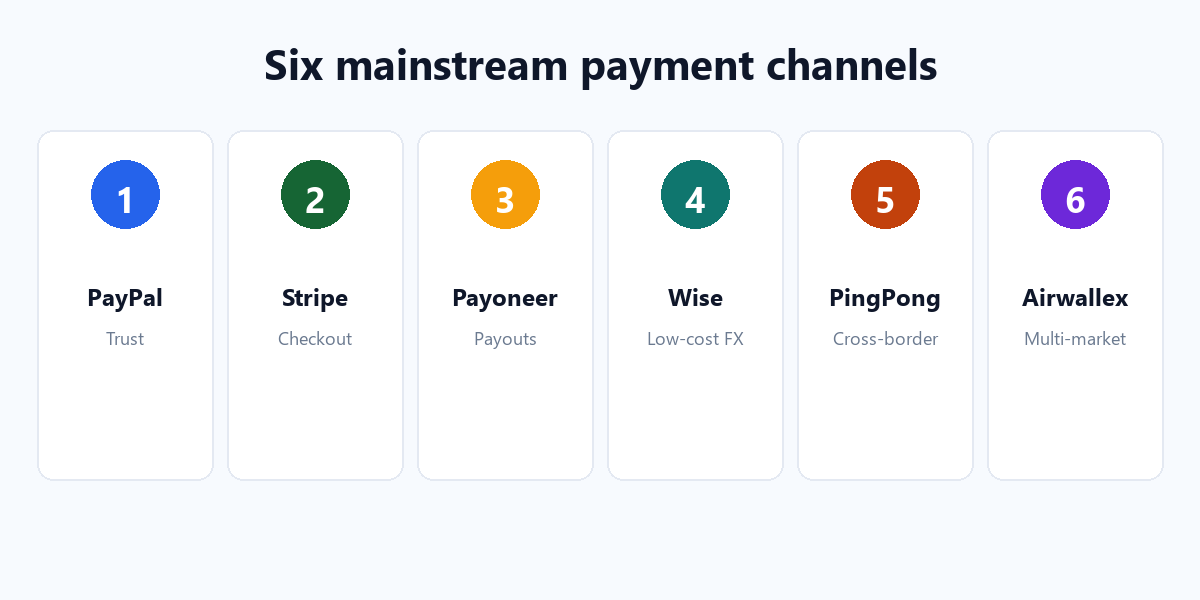
For most independent sites, the winning setup combines three layers: a card gateway for the checkout, PayPal for buyer trust, and a low-cost payout rail to move money home. The mainstream names across those layers are PayPal, Stripe, Payoneer, Wise, PingPong, and Airwallex. Each is explained in full below.
What an independent-site payment channel actually is
An independent site (a self-hosted store, usually built on WordPress or Shopify) is different from selling on a marketplace. On Amazon or eBay, the marketplace handles payment for you. On your own site, you are responsible for the entire checkout: the card processor, the currency conversion, and moving the money into your bank account.
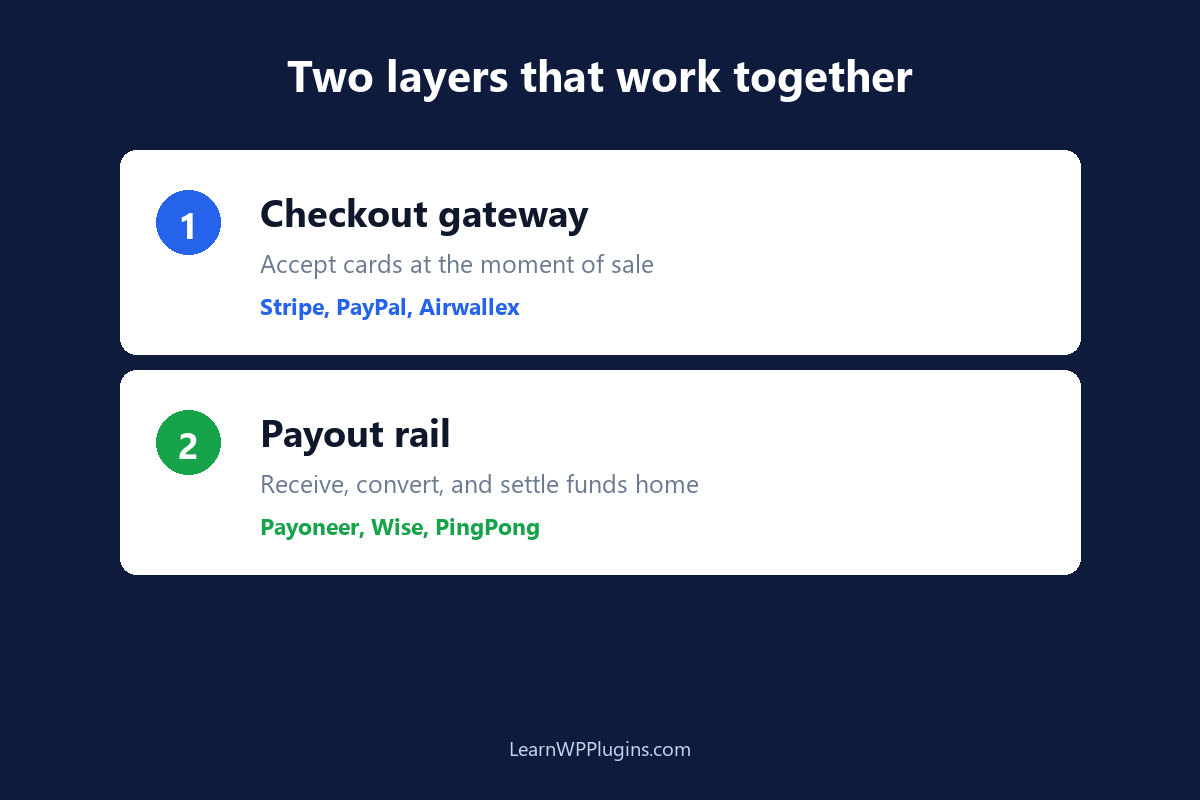
That is why you rarely use just one channel. You typically combine:
- A checkout gateway that accepts cards at the moment of sale (Stripe, PayPal, Airwallex).
- A payout rail that receives and converts funds, then sends them to your local bank (Payoneer, Wise, PingPong).
Understanding this split is half the battle. The sections below evaluate each merchant against the same four questions: what it is, what it costs, who can open an account, and what it is best for.
PayPal — the trust layer
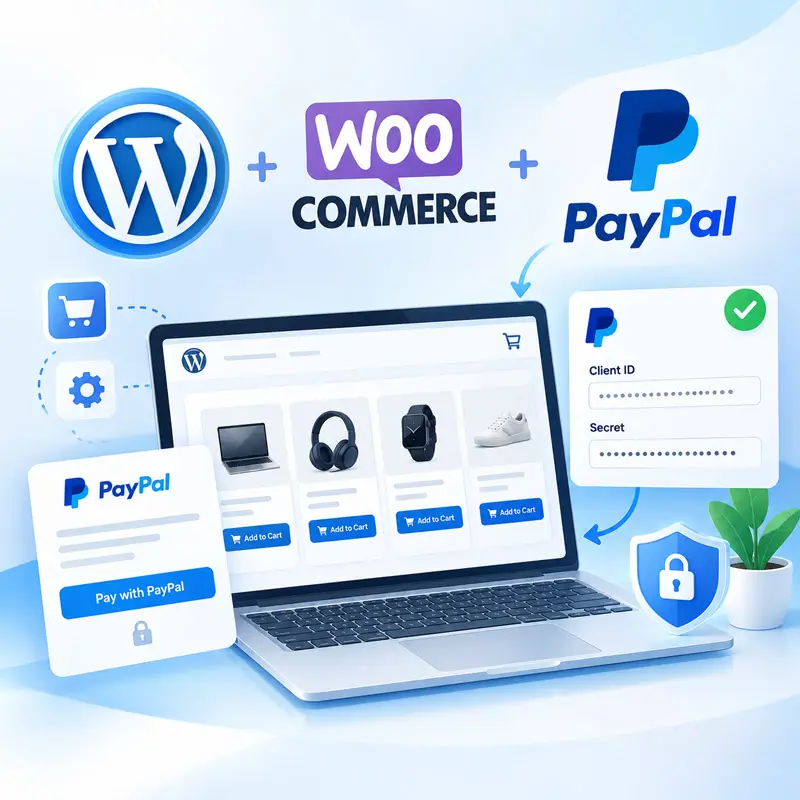
PayPal is the most recognized payment brand in the world, with hundreds of millions of active accounts. For an independent site selling to international buyers, that familiarity translates directly into conversions: a first-time visitor who hesitates to type a card number will often pay with PayPal because they already trust it.
What it costs
Expect roughly 2.99% plus a fixed fee for domestic transactions, rising to around 4.4% plus a fixed fee for international or cross-border sales. Currency conversion adds an extra margin on top.
Who can open an account
Almost anyone. A personal account works to start, and you upgrade to a business account for commercial use. This low barrier is one reason PayPal remains the default first channel for new sellers.
Best for
Buyer trust and conversion. Use PayPal alongside a card gateway, not as your only option.
Stripe — the developer’s gateway
Stripe is the default choice for sites that want a clean, fast checkout, transparent pricing, and the ability to accept many currencies. It is also the strongest option if you plan to sell subscriptions or automate anything around payments, thanks to a well-documented API and a huge ecosystem of plugins.
What it costs
Around 2.9% plus a fixed fee for domestic cards, with roughly an extra 1% for international cards. Stripe publishes its pricing openly, which makes it easy to forecast costs.
Who can open an account
Stripe requires a business registered in a supported country and a local bank account for payouts. This is the main barrier for sellers in countries Stripe does not support.
Best for
Fast checkout, subscriptions, and multi-currency selling when your business is registered in a supported market.
Payoneer — the cross-border payout rail
Payoneer shines when your income already flows through marketplaces or overseas clients rather than only through your own checkout. It gives you local receiving accounts in major currencies, so you can receive payments as if you had a bank account in each country, then withdraw to your local bank at a predictable cost.
What it costs
Opening an account is free. The main costs are conversion and withdrawal fees, typically in the low single-digit range — often cheaper than PayPal’s cross-border markup.
Who can open an account
Individuals and businesses in a wide list of countries, with simple identity verification.
Best for
Receiving marketplace payouts and moving cross-border earnings home efficiently.
Wise — the low-cost currency converter
Wise (formerly TransferWise) is the cheapest way to move money across borders when the real cost is the exchange rate, not the card network. It converts at the mid-market rate with a small, clearly displayed fee, and it gives you a multi-currency account with local bank details in several currencies.
What it costs
Conversion fees are typically well under 1%, depending on the currency and route. There are no hidden exchange-rate markups, which is Wise’s main selling point.
Who can open an account
Easy to open for individuals and businesses in most countries, with standard verification.
Best for
Low-cost currency conversion and holding multiple currencies in one account.
PingPong — built for China cross-border sellers
PingPong is a payment platform aimed squarely at cross-border e-commerce sellers, and it is a favorite among independent-site owners who need to collect money from overseas customers and settle it cleanly to a local bank account. It is especially relevant if you operate from outside the US and Europe.
What it costs
Fees are typically around 1% or lower with volume, designed for cross-border collection. That is significantly cheaper than PayPal or Stripe for the same job.
Who can open an account
Opens with business registration and identity verification, and it is friendly to non-US sellers.
Best for
Cross-border sellers who want low collection fees and simple local settlement.
Airwallex — a global business account with a gateway
Airwallex combines a multi-currency business account with payment acceptance, which means you can collect, hold, convert, and pay out without stitching several services together. It is a strong fit for independent sites that operate across multiple markets.
What it costs
Competitive interchange-plus pricing with low foreign-exchange margins, often a fraction of a percent on conversion.
Who can open an account
Requires a registered business and standard onboarding checks.
Best for
Multi-market operation where you want accounts, conversion, and checkout in one platform.
The mainstream channels, side by side
| Merchant | Typical cost | Best for | Account requirement |
|---|---|---|---|
| PayPal | ~2.99% + fixed, higher cross-border | Buyer trust | Easy, personal or business |
| Stripe | ~2.9% + fixed, +1% international | Fast checkout, subscriptions | Business in supported country |
| Payoneer | Low single-digit conversion/withdrawal | Marketplace payouts | Individual or business |
| Wise | Mid-market FX, under ~1% | Low-cost conversion | Easy, individual or business |
| PingPong | ~1% or lower with volume | Cross-border sellers | Business registration |
| Airwallex | Interchange-plus, low FX | Multi-market operation | Registered business |
How to choose the right combination
There is no single best channel — only the best combination for your market, volume, and where your business is registered. Use these rules to decide:
- Start with a card gateway plus PayPal. Stripe or Airwallex handles the checkout; PayPal catches the buyers who will not type a card number.
- Add a payout rail. Payoneer, Wise, or PingPong receives your funds and settles them to your local bank at a lower cost than a card gateway’s cross-border markup.
- Match the rail to your location. Sellers in China and nearby markets often prefer PingPong; sellers elsewhere lean on Payoneer or Wise.
- Read the full fee schedule, not the headline rate. A low card fee can hide a high currency-conversion margin.
Frequently asked questions
Which payment channel is best for a new independent site?
Start with PayPal plus one card gateway (Stripe or Airwallex). PayPal builds trust with new buyers, and the gateway gives you a clean, low-fee card checkout.
What is the cheapest payment channel for cross-border sales?
For pure cost, Wise is the cheapest way to convert currency, and PingPong or Payoneer are cheap ways to collect and settle. Card gateways (Stripe, PayPal) cost more per transaction but are what make the checkout work.
Do I need a business to open these accounts?
PayPal, Payoneer, and Wise can be opened by individuals. Stripe and Airwallex generally require a registered business. PingPong requires business registration.
Can I use more than one payment channel at once?
Yes, and you should. Offering PayPal plus a card gateway reduces cart abandonment, because buyers can use whichever method they prefer.
Which channel is best for sellers in China?
PingPong and Payoneer are popular with China cross-border sellers because they settle cleanly to local accounts and charge lower collection fees than Stripe or PayPal.
Get the checkout right, then grow
The payment channels you choose are a business decision, not just a technical one. Get the checkout layer working (a card gateway plus PayPal), then add a low-cost payout rail, and your independent site is ready to sell across borders without leaking money on fees.
If you are building the rest of your WordPress store, our WordPress plugin tutorials walk through the plugins and settings that pair with your payment setup. Get the money right first, and every sale after that is a solved problem.